Chinese Peking Rugs

Chinese Peking rugs are admired for their refined elegance, balanced compositions, and subtle color palettes. Originating in northern China around Beijing — historically known as Peking — these carpets blend traditional symbolism with graceful design. Their understated beauty makes them versatile additions to many interiors. Today, collectors and designers value Peking carpets for their craftsmanship, cultural heritage, and enduring place among fine Chinese rugs.

Read More

History of Chinese Peking Rugs

The tradition of Chinese Peking rugs evolved during the late Qing Dynasty and continued into the early twentieth century as global interest in Asian textiles grew. These carpets were often woven in workshops around Beijing and nearby weaving centers. Early examples were sometimes produced for imperial or export markets, blending Chinese artistic traditions with Western demand. Many surviving Peking carpets are now treasured as collectible antique rugs reflecting a distinctive period in Chinese weaving history.

Why Choose Esmaili Rugs

At Esmaili Rugs, we curate exceptional Chinese wool rugs selected for quality, beauty, and historical character. Our gallery presents rare examples of Chinese carpets, along with a refined collection of antique and decorative pieces from across Asia. Whether you are searching for timeless Chinese rugs for sale or expanding a curated collection, our specialists are dedicated to helping you discover remarkable pieces within our distinguished rug store.

Design Characteristics and Motifs

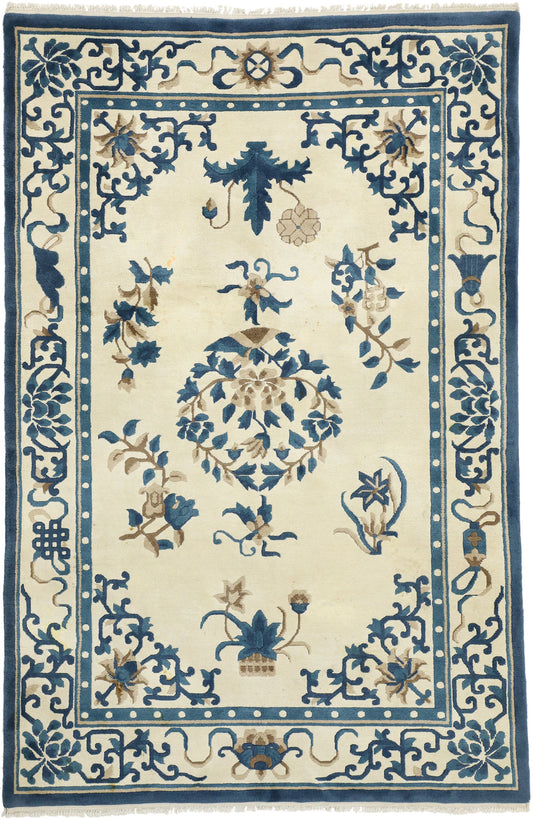
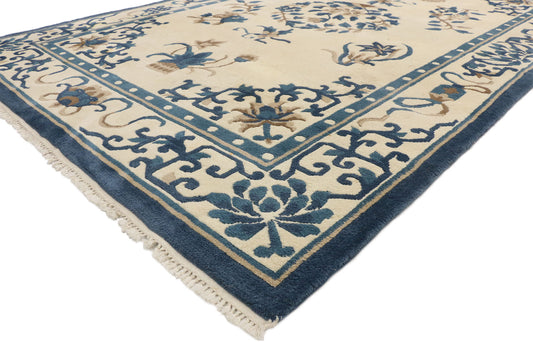
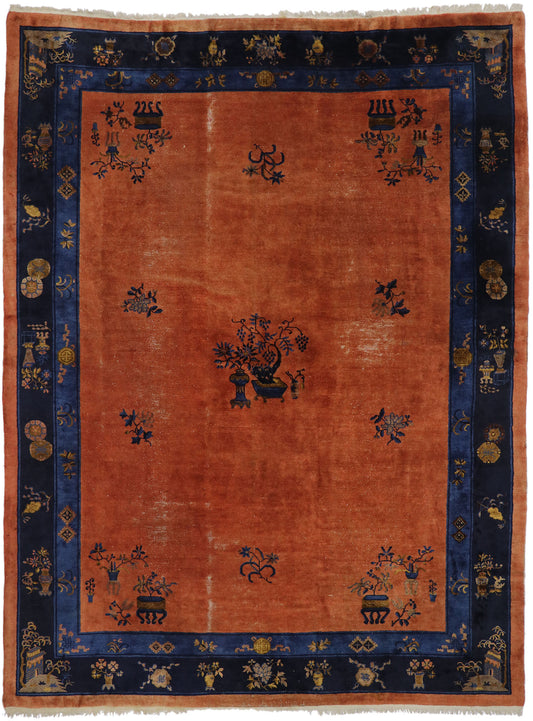
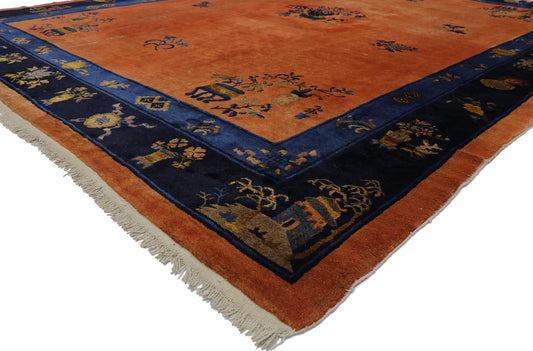
The aesthetic of Chinese Peking rugs is defined by spacious compositions and symbolic motifs drawn from traditional Chinese culture. Designs may include medallions, cloud bands, fretwork borders, or stylized floral forms. Soft blues, golds, ivories, and muted earth tones are common. Many examples are crafted as durable Chinese wool rugs, prized for their smooth texture and understated elegance. A finely woven hand knotted Chinese rug reflects the careful artistry and balance that define this weaving tradition.

Explore Hand Knotted Chinese Rugs at Esmaili Rugs

The graceful simplicity of Chinese Peking rugs allows them to complement both traditional and contemporary interiors. Their balanced designs and elegant palettes make them ideal focal points within refined spaces. Visit our gallery to explore rare and decorative examples of these historic textiles, and consult our experts for professional oriental rug appraisals or trusted rug renewal services that help preserve these remarkable works of art for generations.
FAQs

What are the traditional motifs in Peking carpets?

The signature design aesthetic behind Peking textiles is an exploration of open space, balanced by intricate Asian motifs. You can expect to see large central spaces completely devoid of patterns, accented by borders, corner designs, and central medallions. Most commonly, you’ll see lotus flowers and peonies as the main floral centerpieces, with vases, bats, clouds, and shou symbols throughout.

Each of these subjects is meant to imbue the square rugs and hallway runner rugs with cultural motifs and symbolism, ranging from power and purity to prosperity, good fortune, and longevity.

How are these Chinese wool rugs made?

Peking rugs are made on vertical looms and hand-knotted using a distinctive Chinese variation on the asymmetrical knotting technique. This method creates a durable pile while allowing for the spacious compositions and graceful motifs that define Peking carpets.

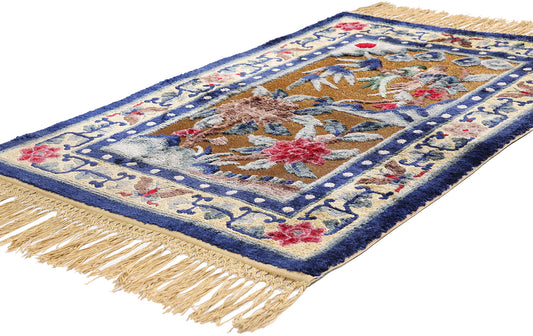
The resulting rug features a standard pile, creating a luxurious living room rug for opulent spaces. While most of these rugs are made with sheep’s wool, a few are made using silk. The foundation of Chinese Peking rugs is traditionally cotton.

Do Chinese Peking rugs only come in blue?

No, while many Peking rugs feature a blue background with soft ivory or gold accents, you can find these pieces in a few different hues. Blue shades are among the most popular, but Esmaili Rugs features a selection of Chinese Peking textiles with gold, yellow, beige, red, and orange as the central hues. However, many of these rugs still incorporate the so-called “Peking blue” as an accent color.